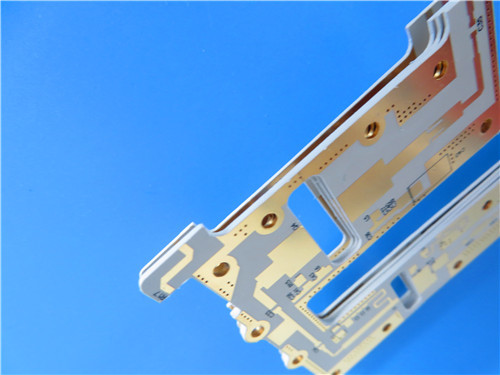
Hi, I'm Sally. Today I'm showcasing a custom PCB built on CLTE-MW—a high-performance, cost-effective laminate designed specifically for applications with thickness constraints, including 5G and millimeter wave designs.
This custom PCB was fabricated using CLTE-MW, a spread-glass reinforced laminate with a low loss tangent of 0.0015 at 10 GHz. An ultra-thin 0.102mm core was specified, resulting in a finished thickness of just 0.2mm. With 6 nets and 43 components, this design is well-suited for commercial communications, avionics, microwave feed networks, and passive components like couplers, filters, and baluns.
Key Takeaways
- Material: CLTE-MW — spread-glass reinforced laminate for millimeter wave applications
- Key Benefit: Ultra-thin construction (0.2mm), low loss, minimized glass weave effects
- Board Size: 35.8mm x 66.5mm | Finished Thickness: 0.2mm (ultra-thin)
- Construction: Double-sided, green solder mask on top only, white silkscreen on top only
- Surface Finish: Pure Gold — ideal for wire-bonding and low-loss RF
- Design: 43 components, 25 vias, 6 nets — a more complex multi-net RF design
- Quality: IPC-Class-2 was met, and 100% electrical testing was performed
A compact RF board was required by our customer for a millimeter wave application where physical thickness constraints were critical. The design needed to maintain low loss at high frequencies while ensuring reliable plated through-holes in an ultra-thin construction. Minimizing glass weave effects was also essential for consistent electromagnetic wave propagation.
CLTE-MW was selected, a laminate specifically engineered for thickness-constrained millimeter wave applications.
Here's why it was chosen:
Ultra-Thin Core (0.102mm / 4.016mil)
CLTE-MW is available in seven thickness options from 3 to 10 mils, ensuring that ideal signal-to-ground spacing exists for 5G and other millimeter wave applications. The 4mil core used here was ideal for the ultra-thin 0.2mm finished thickness.
Spread Glass Reinforcement
The laminate is reinforced with spread glass which, along with high filler loading, helps minimize high-frequency glass weave effects on electromagnetic wave propagation. This ensures consistent Dk and reduced signal distortion.
Low Loss Tangent (0.0015 at 10 GHz)
Low-loss designs were enabled, critical for millimeter wave frequencies where signal attenuation increases significantly.
Low Z-Axis CTE (30 ppm/°C)
Excellent plated through-hole reliability was ensured, even in the ultra-thin construction.
Thermal Conductivity (0.42 W/mK)
Good heat dissipation was provided for aggressive designs.
UL94 V-0 Flammability Rating
Safety was confirmed for commercial and aerospace applications.
Board Specifications
| Feature |
Specification |
| Dimensions |
35.8mm x 66.5mm (±0.15mm) |
| Stackup |
35μm Cu / 0.102mm CLTE-MW / 35μm Cu |
| Finished Thickness |
0.2mm (ultra-thin) |
| Trace/Space |
4/6 mils |
| Min Hole Size |
0.3mm |
| Surface Finish |
Pure Gold |
| Solder Mask |
Green (top only) |
| Silkscreen |
White (top only) |
| Testing |
100% electrical |
| Standard |
IPC-Class-2 |
Design Statistics
| Metric |
Value |
| Components |
43 |
| Total Pads |
27 (19 through-hole, 8 SMT) |
| Vias |
25 |
| Nets |
6 |
The 6-net design represents a more complex circuit than the 2-net designs we've featured previously—likely a multi-port passive component or a small feed network. The 43 components with 27 pads indicate a dense but focused RF design.
Pure Gold Finish
Pure gold was chosen to provide excellent wire-bonding capability and low-loss performance—critical for millimeter wave applications where every fraction of a dB matters.
Green Solder Mask (Top Only)
The top layer was protected with green solder mask, while the bottom remained bare for optimal RF performance.
White Silkscreen (Top Only)
Clear component identification was provided for assembly and troubleshooting.
Ultra-Thin 0.2mm Construction
The extreme thinness was achieved through the 4mil core, enabling compact designs for 5G and millimeter wave applications.
Material Properties: The Numbers Behind CLTE-MW
| Property |
Value |
| Loss Tangent @ 10 GHz |
0.0015 |
| Z-Axis CTE |
30 ppm/°C |
| Thermal Conductivity |
0.42 W/mK |
| Flammability Rating |
UL94 V-0 |
| Available Thicknesses |
3–10 mils (7 options) |
| Reinforcement |
Spread glass with high filler loading |
Why This Matters: CLTE-MW's spread glass reinforcement and high filler loading minimize glass weave effects—a critical factor for millimeter wave designs where signal consistency is paramount.
Comparison: How CLTE-MW Stacks Up
| Property |
CLTE-MW |
CLTE |
Standard FR-4 |
| Loss Tangent @ 10 GHz |
0.0015 |
0.0012 |
0.02–0.03 |
| Z-Axis CTE |
30 ppm/°C |
20 ppm/°C |
50–70 ppm/°C |
| Min Thickness |
3 mils |
5 mils |
4+ mils |
| Glass Weave Effect |
Minimized |
Present |
Present |
| 5G/mmWave Optimized |
Yes |
No |
No |
Why This Matters: CLTE-MW was specifically designed for 5G and millimeter wave applications, offering ultra-thin options and minimized glass weave effects that CLTE and FR-4 cannot match.
Ideal Applications
With its ultra-thin construction, low loss, and minimized glass weave effects, this design is purpose-built for:
- Commercial Communications and Avionics
- Military/Aerospace Applications
- Microwave Feed Networks
- Phase Sensitive Electronic Structures
- Satellite Communication Systems
- Passive Components (couplers, filters, and baluns)
Q: Why was CLTE-MW chosen over standard CLTE?
A: CLTE-MW offers thinner core options (down to 3 mils) and spread glass reinforcement that minimizes glass weave effects—critical for millimeter wave applications.
Q: Why was an ultra-thin 0.2mm construction specified?
A: The thickness constraint was driven by physical or electrical requirements. CLTE-MW's ultra-thin options enabled the design to meet these constraints.
Q: What is the significance of 6 nets compared to 2 nets?
A: A 6-net design represents a more complex multi-port circuit—likely a passive component like a coupler, filter, or balun with multiple input/output ports.
Q: Why was pure gold chosen as the surface finish?
A: Pure gold provides excellent wire-bonding capability and low-loss performance, critical for millimeter wave applications.
Q: What does "spread glass" mean and why does it matter?
A: Spread glass refers to a reinforcement pattern that spreads the glass fibers more uniformly, minimizing the "glass weave effect" that can cause Dk variations and signal distortion at high frequencies.
Q: Is this material suitable for 5G applications?
A: Yes. CLTE-MW was specifically designed with seven thickness options to ensure ideal signal-to-ground spacing for 5G and millimeter wave applications.
CLTE-MW delivers the ultra-thin construction, low loss, and minimized glass weave effects required for 5G and millimeter wave designs. When your application demands thickness-constrained performance at high frequencies, this material delivers.
Got a millimeter wave or 5G project in mind? I'd love to hear about it.


 メッセージは20〜3,000文字にする必要があります。