| MOQ: | 1個 |
| 価格: | 1.99USD/pcs |
| 標準パッケージ: | パッキング |
| 配達期間: | 2~10営業日 |
| 決済方法: | T/T、ペイパル |
| 供給能力: | 50000個 |
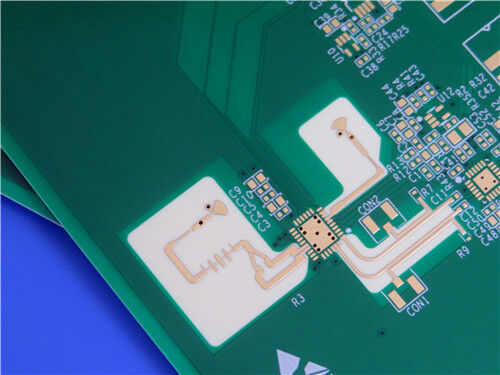
4-Layer Hybrid High-Frequency PCB – RO4003C + FR4 (Immersion Gold)
We present our 4-Layer RO4003C + FR4 Hybrid PCB – a high-performance, cost-effective solution for RF and microwave circuits requiring controlled impedance, low loss, and reliable thermal performance. The top signal layers utilize Rogers RO4003C hydrocarbon ceramic laminate (Dk 3.38 ±0.05, Df 0.0027 @ 10 GHz), while the bottom layers use FR4 (TG175) for mechanical rigidity and cost optimization. This hybrid construction is finished with Immersion Gold (2µ") , green solder mask, and white silkscreen. The board includes controlled depth slots and meets IPC-6012 Class 3 reliability standards, with 25µm copper plating in each hole.
Key Specifications
| Parameter | Details |
| Product Type | 4-Layer Hybrid High-Frequency PCB |
| Base Materials | RO4003C (Top RF section) + FR4 TG175 (Bottom section) |
| Finished Board Thickness | 1.4 mm |
| Board Dimensions | 200 mm × 115 mm = 1 piece |
| Inner Layer Copper Weight | 0.5 oz (17.5 μm) |
| Outer Layer Copper Weight | 1 oz (35 μm) finished |
| Solder Mask | Green (Top & Bottom) |
| Silkscreen | White (Top) |
| Surface Finish | Immersion Gold (ENIG) – 2 microinches (0.05 μm) gold thickness |
| Via Plating Thickness | 25 μm (1 mil) minimum in each hole |
| Special Features | Controlled depth slots (routing) |
| Quality Standard | IPC-6012 Class 3 (High reliability) |
| Electrical Test | 100% prior to shipment |
| Artwork Format | Gerber RS-274-X |
PCB Stackup (4-Layer Hybrid Rigid)
![]()
What is RO4003C?
RO4003C™ is a hydrocarbon ceramic laminate from Rogers Corporation, designed to offer superior high-frequency performance with the ability to be fabricated using standard FR-4 epoxy/glass processing techniques. Unlike PTFE-based materials, RO4003C is a rigid thermoset laminate that does not require specialized via preparation (e.g., sodium etch) and is compatible with automated handling systems.
RO4003C is part of the RO4000® series, which includes RO4350B™ (higher Dk for miniaturization) and RO4835™ (enhanced oxidation resistance).
Key Properties of RO4003C
| Property | Typical Value | Condition | Test Method |
| Dielectric Constant (Dk) – Process | 3.38 ±0.05 | 10 GHz / 23°C | IPC-TM-650 2.5.5.5 |
| Dielectric Constant (Dk) – Design | 3.55 | 8–40 GHz | Differential Phase Length |
| Dissipation Factor (Df) | 0.0027 | 10 GHz / 23°C | IPC-TM-650 2.5.5.5 |
| Dissipation Factor (Df) | 0.0021 | 2.5 GHz / 23°C | IPC-TM-650 2.5.5.5 |
| Thermal Coefficient of Dk (TCDk) | +40 ppm/°C | -50°C to 150°C | IPC-TM-650 2.5.5.5 |
| Volume Resistivity | 1.7 × 10¹⁰ MΩ·cm | COND A | IPC-TM-650 2.5.17.1 |
| Surface Resistivity | 4.2 × 10⁹ MΩ | COND A | IPC-TM-650 2.5.17.1 |
| Electrical Strength | 31.2 KV/mm (780 V/mil) | 0.51 mm (0.020") | IPC-TM-650 2.5.6.2 |
| Tensile Modulus (X) | 19,650 MPa (2,850 ksi) | RT | ASTM D638 |
| Tensile Modulus (Y) | 19,450 MPa (2,821 ksi) | RT | ASTM D638 |
| Tensile Strength (X) | 139 MPa (20.2 ksi) | RT | ASTM D638 |
| Tensile Strength (Y) | 100 MPa (14.5 ksi) | RT | ASTM D638 |
| Flexural Strength | 276 MPa (40 kpsi) | – | IPC-TM-650 2.4.4 |
| Dimensional Stability | <0.3 mm/m (<0.3 mils/inch) | After etch + E2/150°C | IPC-TM-650 2.4.39A |
| CTE – X axis | 11 ppm/°C | -55 to 288°C | IPC-TM-650 2.4.41 |
| CTE – Y axis | 14 ppm/°C | -55 to 288°C | IPC-TM-650 2.4.41 |
| CTE – Z axis | 46 ppm/°C | -55 to 288°C | IPC-TM-650 2.4.41 |
| Tg (TMA) | >280°C | A | IPC-TM-650 2.4.24.3 |
| Td (TGA) | 425°C | – | ASTM D3850 |
| Thermal Conductivity | 0.71 W/m/°K | 80°C | ASTM C518 |
| Moisture Absorption | 0.06% | 48 hrs immersion, 50°C | ASTM D570 |
| Density | 1.79 g/cm³ | 23°C | ASTM D792 |
| Copper Peel Strength | 1.05 N/mm (6.0 pli) | After solder float, 1 oz ED | IPC-TM-650 2.4.8 |
| Flammability | N/A (RO4350B is UL 94 V-0) | – | UL 94 |
| Lead-Free Process Compatible | Yes | – | – |
Standard Thicknesses Available for RO4003C
| Thickness (inches) | Thickness (mm) | Tolerance |
| 0.008" | 0.203 mm | ±0.0010" |
| 0.012" | 0.305 mm | ±0.0010" |
| 0.016" | 0.406 mm | ±0.0015" |
| 0.020" | 0.508 mm | ±0.0015" |
| 0.032" | 0.813 mm | ±0.0020" |
| 0.060" | 1.524 mm | ±0.0040" |
Key Advantages of RO4003C
FR-4 Compatible Processing – Can be fabricated using standard epoxy/glass (FR-4) processes. No specialized via preparation (sodium etch) required.
Stable Dk over Temperature & Frequency – TCDk of +40 ppm/°C is among the lowest of any circuit board material. Dk remains stable from 500 MHz to 40 GHz.
Low Dielectric Loss (Df 0.0027 @ 10 GHz) – Enables use in applications where higher frequencies limit conventional laminates.
Copper-Matched CTE – X/Y CTE of 11–14 ppm/°C closely matches copper (17 ppm/°C), providing excellent dimensional stability and reliable plated through-holes.
High Tg (>280°C) – Expansion characteristics remain stable over entire circuit processing temperature range.
Low Z-axis CTE (46 ppm/°C) – Ensures reliable PTH quality even in severe thermal shock applications.
Typical Applications of RO4003C
Cellular base station power amplifiers & antennas
RF identification (RFID) tags
Satellite radio antennas (SDARS)
Automotive radar (ADAS)
Microwave point-to-point backhaul radios
High-speed digital backplanes
Test & measurement equipment
What is a High-Frequency Hybrid PCB?
A High-Frequency Hybrid PCB is a multilayer printed circuit board that combines two or more different dielectric materials in a single stackup – typically a high-performance RF laminate (e.g., RO4003C) for signal layers and a standard or mid-performance material (e.g., FR4) for non-critical layers.
In this product:
RO4003C is used on Layer 1–2 (top RF section) for low loss, stable Dk, and controlled impedance.
FR4 TG175 is used on Layer 3–4 (bottom section) for mechanical support, power distribution, and cost reduction.
Why Use a Hybrid Construction?
| Driver | Explanation |
| Cost Optimization | High-frequency materials (RO4003C) are expensive. FR4 is significantly cheaper. Using FR4 for non-critical layers reduces total board cost. |
| Mechanical Rigidity | FR4 provides excellent mechanical strength and is well-suited for thick boards, connectors, and large form factors. |
| Thermal Management | Hybrid stackups can be designed to place heat-generating components on the FR4 side with thermal vias to copper planes. |
| Design Flexibility | Allows RF performance where needed (top layers) and standard digital/DC routing where performance requirements are lower (bottom layers). |
| Manufacturing Compatibility | FR4 is universally understood by PCB fabricators. Hybrid boards can be processed with modifications to standard FR4 lines. |
| Advantages of High-Frequency Hybrid PCBs | |
| Advantage | Description |
| Cost-Effective | Reduces material cost by 30–60% compared to all-high-frequency laminates. |
| Excellent RF Performance | Critical signal layers use low-loss, stable Dk materials. |
| Good Thermal Reliability | RO4003C has Tg >280°C; FR4 TG175 supports lead-free assembly. |
| Standard Fabrication | RO4003C is FR4-process-compatible – no PTFE-specific handling. |
| Reliable PTH | Low Z-axis CTE of RO4003C (46 ppm/°C) combined with matched CTE to copper ensures via reliability. |
| Mixed Component Placement | High-frequency components (RFICs, antennas) on RO4003C side; digital ICs, passives, connectors on FR4 side. |
Disadvantages / Challenges of High-Frequency Hybrid PCBs
| Disadvantage | Description | Mitigation |
| Registration Control | Different CTE values between RO4003C (11–14 ppm/°C) and FR4 (14–18 ppm/°C) can cause layer-to-layer misregistration during lamination. | Use matched prepreg systems; optimize lamination cycle. |
| Z-axis CTE Mismatch | RO4003C Z-CTE = 46 ppm/°C; FR4 Z-CTE = 50–60 ppm/°C. Differential expansion stresses plated vias crossing the hybrid interface. | Use ductile copper plating (25μm min); avoid vias directly at material transition. |
| Bonding Reliability | Adhesion between RO4003C and FR4 requires careful prepreg selection (e.g., 2113 RC56% used here). | Follow Rogers RO4400 bondply guidelines. |
| Material Cost | Still higher than all-FR4 boards (but lower than all-high-frequency). | Acceptable trade-off for required RF performance. |
| Fabrication Complexity | Requires fabricator experienced with hybrid laminates; additional process controls needed. | Partner with qualified suppliers (IPC-6012 Class 3). |
| Moisture Sensitivity | RO4003C absorbs 0.06% moisture vs. FR4 ~0.1–0.2%. Minimal difference, but baking before assembly recommended. | Standard pre-assembly bake (120°C for 2–4 hours). |
When to Choose a Hybrid PCB
RF performance is required only on certain layers
Board size is large – all-high-frequency would be cost-prohibitive
Mechanical strength is needed (connectors, mounting holes)
Mixed-signal design (RF + high-speed digital + DC power)
Volume production – hybrid balances performance and cost
Choose all-high-frequency when:
All signal layers require low loss and stable Dk
Budget allows for premium material
Design is very sensitive to CTE mismatch (e.g., high-density interconnects)
Ordering Information
Submit your Gerber RS-274-X files and fabrication drawings with clear indication of:
Controlled depth slot locations and depths
Impedance control requirements (if any)
Netlist for 100% electrical testing
We support prototype to volume production with global shipping.
| MOQ: | 1個 |
| 価格: | 1.99USD/pcs |
| 標準パッケージ: | パッキング |
| 配達期間: | 2~10営業日 |
| 決済方法: | T/T、ペイパル |
| 供給能力: | 50000個 |
4-Layer Hybrid High-Frequency PCB – RO4003C + FR4 (Immersion Gold)
We present our 4-Layer RO4003C + FR4 Hybrid PCB – a high-performance, cost-effective solution for RF and microwave circuits requiring controlled impedance, low loss, and reliable thermal performance. The top signal layers utilize Rogers RO4003C hydrocarbon ceramic laminate (Dk 3.38 ±0.05, Df 0.0027 @ 10 GHz), while the bottom layers use FR4 (TG175) for mechanical rigidity and cost optimization. This hybrid construction is finished with Immersion Gold (2µ") , green solder mask, and white silkscreen. The board includes controlled depth slots and meets IPC-6012 Class 3 reliability standards, with 25µm copper plating in each hole.
Key Specifications
| Parameter | Details |
| Product Type | 4-Layer Hybrid High-Frequency PCB |
| Base Materials | RO4003C (Top RF section) + FR4 TG175 (Bottom section) |
| Finished Board Thickness | 1.4 mm |
| Board Dimensions | 200 mm × 115 mm = 1 piece |
| Inner Layer Copper Weight | 0.5 oz (17.5 μm) |
| Outer Layer Copper Weight | 1 oz (35 μm) finished |
| Solder Mask | Green (Top & Bottom) |
| Silkscreen | White (Top) |
| Surface Finish | Immersion Gold (ENIG) – 2 microinches (0.05 μm) gold thickness |
| Via Plating Thickness | 25 μm (1 mil) minimum in each hole |
| Special Features | Controlled depth slots (routing) |
| Quality Standard | IPC-6012 Class 3 (High reliability) |
| Electrical Test | 100% prior to shipment |
| Artwork Format | Gerber RS-274-X |
PCB Stackup (4-Layer Hybrid Rigid)
![]()
What is RO4003C?
RO4003C™ is a hydrocarbon ceramic laminate from Rogers Corporation, designed to offer superior high-frequency performance with the ability to be fabricated using standard FR-4 epoxy/glass processing techniques. Unlike PTFE-based materials, RO4003C is a rigid thermoset laminate that does not require specialized via preparation (e.g., sodium etch) and is compatible with automated handling systems.
RO4003C is part of the RO4000® series, which includes RO4350B™ (higher Dk for miniaturization) and RO4835™ (enhanced oxidation resistance).
Key Properties of RO4003C
| Property | Typical Value | Condition | Test Method |
| Dielectric Constant (Dk) – Process | 3.38 ±0.05 | 10 GHz / 23°C | IPC-TM-650 2.5.5.5 |
| Dielectric Constant (Dk) – Design | 3.55 | 8–40 GHz | Differential Phase Length |
| Dissipation Factor (Df) | 0.0027 | 10 GHz / 23°C | IPC-TM-650 2.5.5.5 |
| Dissipation Factor (Df) | 0.0021 | 2.5 GHz / 23°C | IPC-TM-650 2.5.5.5 |
| Thermal Coefficient of Dk (TCDk) | +40 ppm/°C | -50°C to 150°C | IPC-TM-650 2.5.5.5 |
| Volume Resistivity | 1.7 × 10¹⁰ MΩ·cm | COND A | IPC-TM-650 2.5.17.1 |
| Surface Resistivity | 4.2 × 10⁹ MΩ | COND A | IPC-TM-650 2.5.17.1 |
| Electrical Strength | 31.2 KV/mm (780 V/mil) | 0.51 mm (0.020") | IPC-TM-650 2.5.6.2 |
| Tensile Modulus (X) | 19,650 MPa (2,850 ksi) | RT | ASTM D638 |
| Tensile Modulus (Y) | 19,450 MPa (2,821 ksi) | RT | ASTM D638 |
| Tensile Strength (X) | 139 MPa (20.2 ksi) | RT | ASTM D638 |
| Tensile Strength (Y) | 100 MPa (14.5 ksi) | RT | ASTM D638 |
| Flexural Strength | 276 MPa (40 kpsi) | – | IPC-TM-650 2.4.4 |
| Dimensional Stability | <0.3 mm/m (<0.3 mils/inch) | After etch + E2/150°C | IPC-TM-650 2.4.39A |
| CTE – X axis | 11 ppm/°C | -55 to 288°C | IPC-TM-650 2.4.41 |
| CTE – Y axis | 14 ppm/°C | -55 to 288°C | IPC-TM-650 2.4.41 |
| CTE – Z axis | 46 ppm/°C | -55 to 288°C | IPC-TM-650 2.4.41 |
| Tg (TMA) | >280°C | A | IPC-TM-650 2.4.24.3 |
| Td (TGA) | 425°C | – | ASTM D3850 |
| Thermal Conductivity | 0.71 W/m/°K | 80°C | ASTM C518 |
| Moisture Absorption | 0.06% | 48 hrs immersion, 50°C | ASTM D570 |
| Density | 1.79 g/cm³ | 23°C | ASTM D792 |
| Copper Peel Strength | 1.05 N/mm (6.0 pli) | After solder float, 1 oz ED | IPC-TM-650 2.4.8 |
| Flammability | N/A (RO4350B is UL 94 V-0) | – | UL 94 |
| Lead-Free Process Compatible | Yes | – | – |
Standard Thicknesses Available for RO4003C
| Thickness (inches) | Thickness (mm) | Tolerance |
| 0.008" | 0.203 mm | ±0.0010" |
| 0.012" | 0.305 mm | ±0.0010" |
| 0.016" | 0.406 mm | ±0.0015" |
| 0.020" | 0.508 mm | ±0.0015" |
| 0.032" | 0.813 mm | ±0.0020" |
| 0.060" | 1.524 mm | ±0.0040" |
Key Advantages of RO4003C
FR-4 Compatible Processing – Can be fabricated using standard epoxy/glass (FR-4) processes. No specialized via preparation (sodium etch) required.
Stable Dk over Temperature & Frequency – TCDk of +40 ppm/°C is among the lowest of any circuit board material. Dk remains stable from 500 MHz to 40 GHz.
Low Dielectric Loss (Df 0.0027 @ 10 GHz) – Enables use in applications where higher frequencies limit conventional laminates.
Copper-Matched CTE – X/Y CTE of 11–14 ppm/°C closely matches copper (17 ppm/°C), providing excellent dimensional stability and reliable plated through-holes.
High Tg (>280°C) – Expansion characteristics remain stable over entire circuit processing temperature range.
Low Z-axis CTE (46 ppm/°C) – Ensures reliable PTH quality even in severe thermal shock applications.
Typical Applications of RO4003C
Cellular base station power amplifiers & antennas
RF identification (RFID) tags
Satellite radio antennas (SDARS)
Automotive radar (ADAS)
Microwave point-to-point backhaul radios
High-speed digital backplanes
Test & measurement equipment
What is a High-Frequency Hybrid PCB?
A High-Frequency Hybrid PCB is a multilayer printed circuit board that combines two or more different dielectric materials in a single stackup – typically a high-performance RF laminate (e.g., RO4003C) for signal layers and a standard or mid-performance material (e.g., FR4) for non-critical layers.
In this product:
RO4003C is used on Layer 1–2 (top RF section) for low loss, stable Dk, and controlled impedance.
FR4 TG175 is used on Layer 3–4 (bottom section) for mechanical support, power distribution, and cost reduction.
Why Use a Hybrid Construction?
| Driver | Explanation |
| Cost Optimization | High-frequency materials (RO4003C) are expensive. FR4 is significantly cheaper. Using FR4 for non-critical layers reduces total board cost. |
| Mechanical Rigidity | FR4 provides excellent mechanical strength and is well-suited for thick boards, connectors, and large form factors. |
| Thermal Management | Hybrid stackups can be designed to place heat-generating components on the FR4 side with thermal vias to copper planes. |
| Design Flexibility | Allows RF performance where needed (top layers) and standard digital/DC routing where performance requirements are lower (bottom layers). |
| Manufacturing Compatibility | FR4 is universally understood by PCB fabricators. Hybrid boards can be processed with modifications to standard FR4 lines. |
| Advantages of High-Frequency Hybrid PCBs | |
| Advantage | Description |
| Cost-Effective | Reduces material cost by 30–60% compared to all-high-frequency laminates. |
| Excellent RF Performance | Critical signal layers use low-loss, stable Dk materials. |
| Good Thermal Reliability | RO4003C has Tg >280°C; FR4 TG175 supports lead-free assembly. |
| Standard Fabrication | RO4003C is FR4-process-compatible – no PTFE-specific handling. |
| Reliable PTH | Low Z-axis CTE of RO4003C (46 ppm/°C) combined with matched CTE to copper ensures via reliability. |
| Mixed Component Placement | High-frequency components (RFICs, antennas) on RO4003C side; digital ICs, passives, connectors on FR4 side. |
Disadvantages / Challenges of High-Frequency Hybrid PCBs
| Disadvantage | Description | Mitigation |
| Registration Control | Different CTE values between RO4003C (11–14 ppm/°C) and FR4 (14–18 ppm/°C) can cause layer-to-layer misregistration during lamination. | Use matched prepreg systems; optimize lamination cycle. |
| Z-axis CTE Mismatch | RO4003C Z-CTE = 46 ppm/°C; FR4 Z-CTE = 50–60 ppm/°C. Differential expansion stresses plated vias crossing the hybrid interface. | Use ductile copper plating (25μm min); avoid vias directly at material transition. |
| Bonding Reliability | Adhesion between RO4003C and FR4 requires careful prepreg selection (e.g., 2113 RC56% used here). | Follow Rogers RO4400 bondply guidelines. |
| Material Cost | Still higher than all-FR4 boards (but lower than all-high-frequency). | Acceptable trade-off for required RF performance. |
| Fabrication Complexity | Requires fabricator experienced with hybrid laminates; additional process controls needed. | Partner with qualified suppliers (IPC-6012 Class 3). |
| Moisture Sensitivity | RO4003C absorbs 0.06% moisture vs. FR4 ~0.1–0.2%. Minimal difference, but baking before assembly recommended. | Standard pre-assembly bake (120°C for 2–4 hours). |
When to Choose a Hybrid PCB
RF performance is required only on certain layers
Board size is large – all-high-frequency would be cost-prohibitive
Mechanical strength is needed (connectors, mounting holes)
Mixed-signal design (RF + high-speed digital + DC power)
Volume production – hybrid balances performance and cost
Choose all-high-frequency when:
All signal layers require low loss and stable Dk
Budget allows for premium material
Design is very sensitive to CTE mismatch (e.g., high-density interconnects)
Ordering Information
Submit your Gerber RS-274-X files and fabrication drawings with clear indication of:
Controlled depth slot locations and depths
Impedance control requirements (if any)
Netlist for 100% electrical testing
We support prototype to volume production with global shipping.